Showing posts with label State Parks. Show all posts

Sunday, August 20, 2017

Trinidad, on the Santa Fe Trail - Where Cultures Meet

Friday, August 19
It was 34 degrees when we woke up this morning - better than yesterday's 29 but still a might chilly for August. We packed up quickly (moving keeps you warm!) and were on the road by 9:00, our destination is Trinidad State Park.

What a beautiful drive from Molly Brown campground. We soon left the pine forest behind and found ourselves in lush range land, with ranches and rolling pastures dotted with cattle. That terrain evolved into sage and juniper, high desert, then the trees grew bigger and we were in forest again.
All of it beautiful, with interesting mountains in the distance. As we drew closer to Trinidad the rock grew redder, a nice contrast to the cloudy sky.

We were setting up in Trinidad State Park by around 3 P.M. and it was in the mid 80's. Siesta inspiring for all concerned!

After dinner an evening stroll around the immediate portions of the campground was very enjoyable, as we are still high enough that the evenings cool off quickly.

This is a very nice park, with several access points on the water for fishing and boating. We're staying in Carpios Ridge Campground, which has nicely graveled sites, most fairly level, some with a view of the lake, but there's no swimming for human or canine unless you can find one of the little muddy fingers of the lake.

In most places the shore is too steep to make swimming practical.  Boating, water skiing, fishing, hiking, etc. are all accommodated, so, sorry pups, maybe at the next stop! They've done a fairly nice job of spacing sites around the loops, but of all the campgrounds we've stayed in on this trip, other than Prineville this is probably the least private site we've had. There are a few trails around the edges so at least we have interesting walking spaces.

There are interpretive kiosks all around the park.
One, near the amphitheater, features a horno, a primitive oven used by Native Americans as well as the Hispanic settlers in the early days.
Other information kiosks tell of various aspects Spanish/Mexican colonial era, the pioneers, and the Native Americans in the area.


Saturday

Today is work day, and a bit of touring. Laundry first, before the two campground machines  fill up! and then a little time in town.

Trinidad isn't a huge town, the current population is a little over 9,000, but you can tell by the historic downtown area that it was once a very prosperous and bustling city. They are working at bringing back the historic section, with art galleries, restaurants and other interesting shops, but there are many vacant spaces and buildings in desperate need of restoration.
The Bloom Mansion

Originally a coal mining and shipping center, Trinidad had a bustling economy until the mining slowed down. The Wikipedia article on Trinidad has some very interesting information on the town and is defiantly worth the read, especially the section titled "Recent".

We had noticed signs for the Santa Fe Trail museum when we passed through town on our way to the campground, so decided that would make a good destination for the day. It's a good thing there was plenty of on-street parking, as the dark clouds decided to open up just as we arrived in town. Pounding rain, the kind that happens when the air is warm and the clouds are so full they just can't hold any more. Yes, we have an umbrella, and yes, it was safely tucked away in the trailer.

We dashed to the museum, shaking off the water like wet dogs, and of course, the rain quit shortly thereafter. The Santa Fe Trail museum takes up an entire block and is a combination of homes, gardens and traditional museum displays.

The two restored homes in the complex can be toured with a guide, for a small fee, but the remainder of the complex is accessible for no charge. It's a pleasant place to wander the gardens (when it's not raining) and in fact the entire neighborhood is interesting, with historic buildings all around.

Among the museum displays we ran into a new term that, surprisingly, we had not encountered before........."Hispano" Though the word is Spanish in origin, it's meaning when used in English was established for census purposes in the 1930's.  Hispano refers to individuals of Spanish Colonial ancestry who have lived here for generations and maintained that culture. They did not cross a border to move to the area, the border was drawn around them. In Texas the term Tejano has a similar meaning for individuals of Mexican ancestry and cultural identity.

Fort Wooten is very close to the museum and immediately caught our eye as it's military design contrasts with the many Victorian era homes in the area.

It was originally design as a military memorial and home for community veterans groups, but never saw use for that purpose. It's now home to the social service agency. The gate to the courtyard is locked, but it's good to know the building is in use as that will help prevent vandalism and deterioration.

In the afternoon I explored one of the trails that leads down to the edge of the water. I didn't make it all the way, as when I turned around and looked at the trail I reminded myself that what goes down must go back up again! Watch reminded me too.
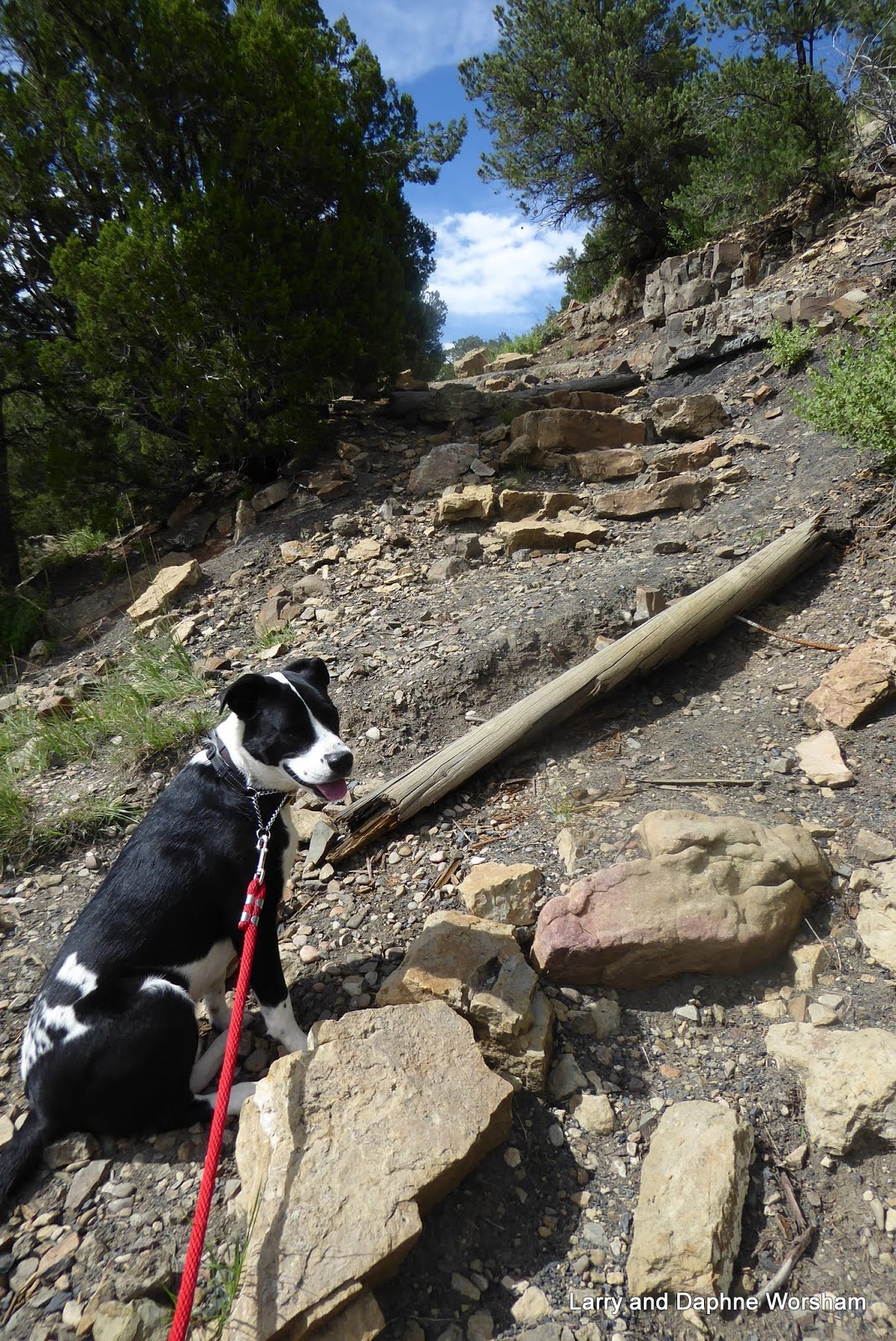
I have to go back up?
Why did we come down?

The trail is rough and fairly steep, but also provides an opportunity for some close up inspection of the geology here.

There's a fairly noticeable of (low grade) coal running along the side of the trail, and the red and buff colored sandstone layers sparkle like glitter in the sun, the result of a high mica content.

There's a lot to explore in Trinidad, more museums and shops, and there are some amazing sculptures along the main street.

We've enjoyed the relatively cool weather this altitude offers, so we'll be back!

Sunday
Time to pack up and head for New Mexico.

If the sunrise this morning is an omen, it's going to be a good day!

More photos here


Friday, August 4, 2017

LaGrande and Wallowa State Park

June 29-30  La Grande, Oregon

A prosperous looking little town, La Grande has a long history. The first permanent settler was in 1861. There's been a lot of history here since then. The influence of cattle ranching is seen in the really wide streets - nice if you're towing or driving a big RV!

Grande Hot Springs RV park is home base - a new name for the park we stayed in last time. They've added a few new features since we were here last, including an additional laundry facility.
Ladd Marsh Wildlife Area is right across the road, and there's a canal running across the back side of the RV park, so it's a good location for bird watchers.

This is another of those quick stops, laundry, shopping, any needed repairs, and then on to four days at Wallowa State Park.

I could only identify one quilt shop in town, so paid them a brief visit when we ran a couple of errands. The shop in is the older downtown part of LaGrand, and while we weren't really in the market for shopping or browsing at the moment, there are a lot of attractive little specialty shops in the area. The La Grande Quilt Shop has a nice range of fabrics, but my space is limited so I only picked up a few interesting fat quarters.


We visited LaGrande in 2011 for trailer a trailer repair, as the Arctic Fox factory is here. We had no major repairs needed this time, but did develop a problem.

One afternoon we noticed we had no water on the hot water side of all the faucets. A bit of research and a lot of crawling around in tight spaces revealed the problem. It was Sunday, of course, so no parts were available, but as it turns out, we don't really need to replaced the valve. It's unnecessary unless you are planning to use antifreeze in winterizing the water system, which we never do. Problem solved!

Not much has changed in the area since our last visit except the name changes. Our comments on the interesting features of the hotel (now called Hot Springs Lake B&B) and the RV park (now called Grande Hot Springs RV Park) at that came are in this post.


July 31- August 3    Wallowa Lake State Park

They call the Wallowa Mountains the Little Alps, and you can see why.

First views of the mountain range from the highway are breathtaking, and in spite of the hot weather there are still little patches of snow here and there on the mountain peaks.


Steve has had Wallowa Lake State Park on his bucket list for a long time, and we finally made it! . . and it was a close call! When making reservations months ago he found it was already booked up, but put his name on the wait list. A short time before we left Texas he received an email message saying they'd had a cancellation, so he snapped it up.

Considering we had no choice in the matter, we got lucky and really have a great site. It's on an end, so our sitting area is much more spacious than most, and we are only a few steps from the entrance to the nature trail, which is handy for the dogs.

This park is huge ( 209 sites) , and very densely populated ..... the complete opposite of Clyde Holiday.

They've done a great job of working in around huge fir trees though, so there's a lot of shade.

We've never seen such a busy campground! All day and into the evening people there are wandering around, adults talking in groups, kids riding bikes (we've seen some pretty amazing bike helmets), young parents chasing their toddlers, people walking dogs (it seems everyone has at least one dog) and two enterprising young men made several firewood deliveries, pushing the little firewood carts while riding their skateboards. Now THAT was entertaining!

The park has a small but adequate off-leash dog area down by the marina, and it works well for the evening ball games. We also went swimming at one of the day use boat ramp areas. Otherwise, life is fairly restricted for the canine set.

Views of this beautiful lake can be had from the highway and the shore, but the campground isn't really situated in a way to afford that kind of scenery. This is where a boat would be handy, but we've given up hauling our canoes. We enjoyed several short excursions around the park to explore the little trails and views of the lake, and to play ball with the pups of course!


The little town of Joseph is just north of the state park, and the closest place for groceries and other services. Joseph is a beautiful town with a long history. It was established as far back as 1883. Originally a ranching and logging community, the town has now evolved into an art colony and tourism center. Summer visitors come for the beautiful views, fall visitors for the hunting, and winter for the snow sports. If you want to shop the galleries gift shops and eateries, you can do that year round too. And of course, there's a quilt shop!


Cattle Country Quilts didn't disappoint. They have some wonderful fabrics that really fit with the themes of the area. I couldn't resist a winter themed piece, and a license plate of course!

We stopped in to the local museum and chatted with their docents who are well versed in the history and family names. They can fill you in on all the artifacts displayed there, as well as Nez Perce tribe history, and anything else you want to know about the area.

Main street is an art walk every day, featuring several bronzes from local artists, cast in the city's foundry. We had lunch in an outdoor restaurant and really enjoyed the views.
The photo album includes larger versions of each sculpture
We also stopped at Old Chief Joseph's cemetery on the way back to camp. There's so much to do and explore here it's hard to fit it all in.

Wednesday we took the Wallowa Mountain Loop to the Hells Canyon Overlook

Photos of these huge mountains and steep valleys covered with trees just wouldn't convey the real message, so I didn't even try. What we did notice as unusual was the extremely tall snags standing far above the obviously younger, and very dense, fir trees.

Checking later I found this is the result of the Canal Fire, where a lightning-caused fire burned 23,000 acres in 1989. The younger trees (28 years since the fire) are so dense that they really need to be thinned, and there are discussions about how to go about that now.

We really enjoyed the drive to Hells Canyon Overlook. It's another one of those amazing, overwhelming scenic views. It's so large it's difficult to convey, a little like the Grand Canyon, and the smoke from forest fires was beginning to creep in.


We really enjoyed the drive, stopping along the way to admire several of the creeks that crisscross the road, visiting the fish weir, and stopping for lunch at a small fishing pond. The dogs seem to enjoy the scenery from the truck as well as getting out to explore each time we stop.

On our last day we drove north to the town of Wallowa to visit the Nez Perce Homeland Interpretive Center. The project office is in an unpretentious little building directly across from the post office, and we almost missed it. The displays aren't extensive, but there are some beautiful artifacts, excellent maps and explanatory displays, and the office is staffed by an enthusiastic and very knowledgeable young woman. The office will provide you with a brochure that includes a map to the nearby Homelands project, where you can walk a trail with interpretive markers along the Wallowa River, visit the dance arbor and longhouse, and enjoy some very special views of the Nez Perce homelands.

We've followed the Nez Perce trail in bits and pieces, starting at the end and now, we've worked our way to the beginning, so we've completed the route. If you are interested in Native American history this is a worthwhile side trip.

On the way back to camp we stopped in to take a look at Wallowa Lake Lodge, which is located right before the entrance to the campground. The lodge was built in 1923, and was really thriving when our daughter's choir performed there (many years ago!) but apparently was about to go under when a small group of investors gathered together to rescue it in 2015. It would have been so sad to see the lodge close. It's a wonderful example of the classic lodge style, beautifully maintained, and exemplifies the gracious feel of the older park lodges throughout the west.
Reception area and main lounge
I said at the beginning the views of the mountains here are amazing, and they really are. Unfortunately, fires in the area began pushing smoke in, and by our third day the mountains were barely visible. I'm glad I didn't wait to take photos. This was taken the morning of the third day, and the smoke got progressively worse. 

Smoke over Wallowa Lake

We really enjoyed our time here, but now we're packing up and heading for a few days in Utah!

Photo Album here 


Monday, May 29, 2017

Caprock Canyons State Park, TX

Friday, May 26
Lake Colorado City
We stayed here in 2013, back when the drought was pretty bad, so there was little water in the lake. Now, the lake is looking pretty good, very picturesque, surrounded by red, rocky cliffs and cactus. It's hard to get to the water though, so no swimming for the dogs. Typical of reservoirs, the lake walls are steep, and in most place dense with cactus and brush. It's a good lake for boat fishing, and there's an area set aside for shore fishing, so a little something for everyone. It was HOT, but we managed to chase the shade and rest up a bit from all the loading up chores. More fun tomorrow!


Saturday, May 27
We're up and out early, and on to the next stop, Cap Rock Canyons State Park.

Access to the park is through a little town named Quitaque. You could work all day at trying to figure out how they pronounce that, so I'll save you some time. . . they put the phonetic spelling up on the sign coming into town, . . .  it's "Kitty-quay". Quitaque is billed as The Bison Capital of Texas, as the state park is home to the Texas State Bison Herd. The bison theme is evident all over this little town, population 411. Yes, that's about all it's been for many years, but it the cutest, cleanest little town we've ever seen. This beautiful mural is on the wall of what turned out to be a solid block of empty shops, the windows of which are all filled with wonderful museum type displays.

All the shop doors along the block are emblazoned with the Quintaque Country Club logo.  There are a few business still in operation - cafe, gas, groceries, farm supplies etc. There's also a pottery studio, beautifully interpreting the bison theme on their walls.

Our first afternoon in the campground was spent trying to keep the rig below the 102 degrees outside. The weather was predicted to be cooling, and it did. A terrific wind came up during the night, and by 5:30 the next morning (Sunday) the temperature had dropped to 56. Seems there's no middle ground around here!

The natural history of  this park is interesting, and old. These brilliant red spires were carved by river erosion into layers of sandstone laid down  280-250 million years ago, when this area was still under the ocean. Now, the land is high plains prairie, covered with grass, junipers, and a wide variety of other plant life. The park is a network of trails of various lengths, allowing everyone to get up close to the geology, but you can see a lot just following the park road to the various campground sections. The views are spectacular! These cliffs are a deeper red than any we have seen previously.

 Archaeological evidence puts humans and bison here 10-12,000 years ago. A nicely arranged information area has a replica of the bones found locally and also a nice shelter with additional information, and a lot of cliff swallows that are also taking advantage of the shelter.

The park is home to bats, a fern cave, antelope, prairie dogs, many varieties of birds, and . . . as evidence shows, some very large rattle snakes!
   
It makes sense that in an area with protected prairie the original occupants would thrive, so the park is home to the Texas State Bison Herd.
This is a unique herd of southern plains bison.
At his wife * Mary Ann's urging, famed cattleman Charles Goodnight started the herd in 1878. It is one of the five foundation herds that saved this animal from extinction.

From the park brochure, "Following the death of the Goodnights, the herd eventually faded from public awareness until wildlife conservationist Wolfgang Frey learned about the remaining herd of 50 or so bison on the JA Ranch and contacted the state of Texas in 1994. After genetic testing by the Texas Parks and Wildlife Department, a rare genetic marker was discovered within the herd revealing it to be perhaps the last remaining group of southern plains bison. The JA Ranch donated the herd to Texas Parks and Wildlife, and in 1997 they were moved to Caprock Canyons State Park. Unique not only in its historical importance but also in its rare genetic makeup, the herd has been designated."
  ( * The link from Mary Ann's name provides a great history of the herd - worth the read!)

We heard from a ranger while we were at our last stop they were nursing a snake-bit buffalo calf here (sorry - bison - old habits - bison calf), so upon arrival we asked about it. It turns out, the cow had abandoned the calf, and that's why they had to bottle feed it, and it was also being treated for the rattlesnake bite. 'Not sure which event came first, but the little one is reported to be doing well.

We stayed in Honey Flat, space 14. Most of the full service (water and electric) campsites are comfortably wide, set back from the road, and carved into the brush so you have a bit of privacy. The park also provides a range of tenting and no service options. Restrooms with showers are available, but limited.

We've really enjoyed our stay here and there's plenty to do if we come back again. It's a beautiful park!


Caprock Canyons album

Tomorrow we depart for Kansas.